

The Retail Worker Safety Act: What the Silent Response Button Requirement Means for Your Stores
by Linaeya Horn-Muller, on Oct 5, 2026, 8:15:00 AM
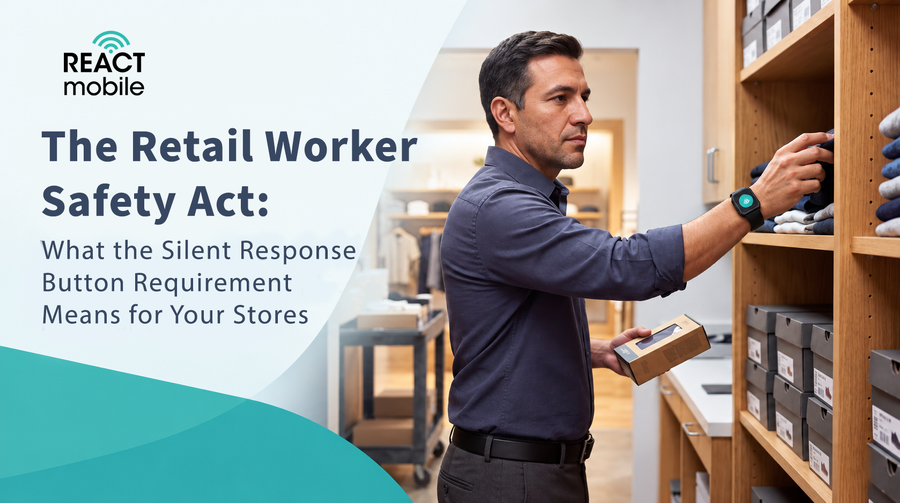
Retail work has gotten more dangerous, and New York lawmakers have taken notice. The Retail Worker Safety Act (NYS Labor Law Section 27-e) was built to give frontline retail employees real protection against workplace violence, and one of its most consequential provisions is now on the clock: the silent response button requirement.
If you operate retail locations in New York, here is what you need to know, and why the clock matters more than it might seem.
What the Law Requires
The Act applies broadly. Any employer with 10 or more retail employees in New York State must adopt a written workplace violence prevention policy, deliver violence prevention training, and meet employee notice requirements. Those obligations have been in effect since June 2025.
The silent response button requirement is narrower but higher stakes. Starting January 1, 2027, employers with 500 or more retail employees statewide must give every retail employee access to a silent response button. When pressed, the button has to request immediate assistance from a security officer, manager, or supervisor. It has to be easy to reach in the moment an employee actually needs it. And employees have to be trained on how and when to use it.
Why "Silent" Is the Whole Point
The law didn't start out this way. As originally written, the Act called for panic buttons that connected directly to law enforcement, dispatching 911 the moment an employee hit the button. Lawmakers walked that back. The amended version replaces the panic button with a silent response button that routes to internal staff instead of external dispatch.
The reasoning is practical. Most incidents that trigger these buttons don't need a 911 response. A shoplifter who won't leave, a customer escalating at the register, an employee who feels unsafe walking to their car. Sending police to every one of those moments risks flooding emergency services with calls that don't need that level of response, and it can escalate situations that would have de-escalated with a manager stepping in. The silent response button gets help to the employee fast, without the overcorrection.
What Actually Counts as a Silent Response Button
New York gave employers real flexibility here. A silent response button can be a physical button installed in the workplace, a wearable device, or a mobile phone application. What it can't be is bring-your-own-device. Any wearable or mobile option has to run on employer-provided equipment, and location tracking is only permitted at the moment the button is triggered, not as a standing feature.
That last detail matters more than it might look at first glance. Employers need a solution that protects employees without turning into a surveillance tool, and that balance has to be built into the device, not bolted on as a policy promise.
The Compliance Window Is Closer Than It Looks
January 1, 2027 sounds far off until you account for what actually has to happen before that date: selecting a device, provisioning it across every covered location, training every retail employee on how to use it, and building the internal response protocol that makes the button meaningful the first time someone presses it. None of that happens overnight, and none of it should be rushed.
Retailers who wait until the deadline is close will be competing for the same vendor capacity, the same installation windows, and the same training bandwidth as every other covered employer in the state. Starting now isn't just good practice. It's the difference between a rollout your team can actually absorb and a scramble.
Where React Mobile Fits
This is exactly the problem our wearable panic button and two-way voice devices were built to solve. They give employees a fast, discreet way to call for help, they connect to internal staff rather than external dispatch by default, and they run on employer-provided hardware, which keeps you squarely inside the law's requirements around tracking and equipment.
If you're mapping out what compliance looks like across your locations, we're glad to help you get ahead of the January 2027 deadline. Request a free demo today.