

Floor-Level vs. Room-Level: The Location Gap That Defines Modern Staff Safety
by Linaeya Horn-Muller, on May 7, 2026, 8:11:07 AM
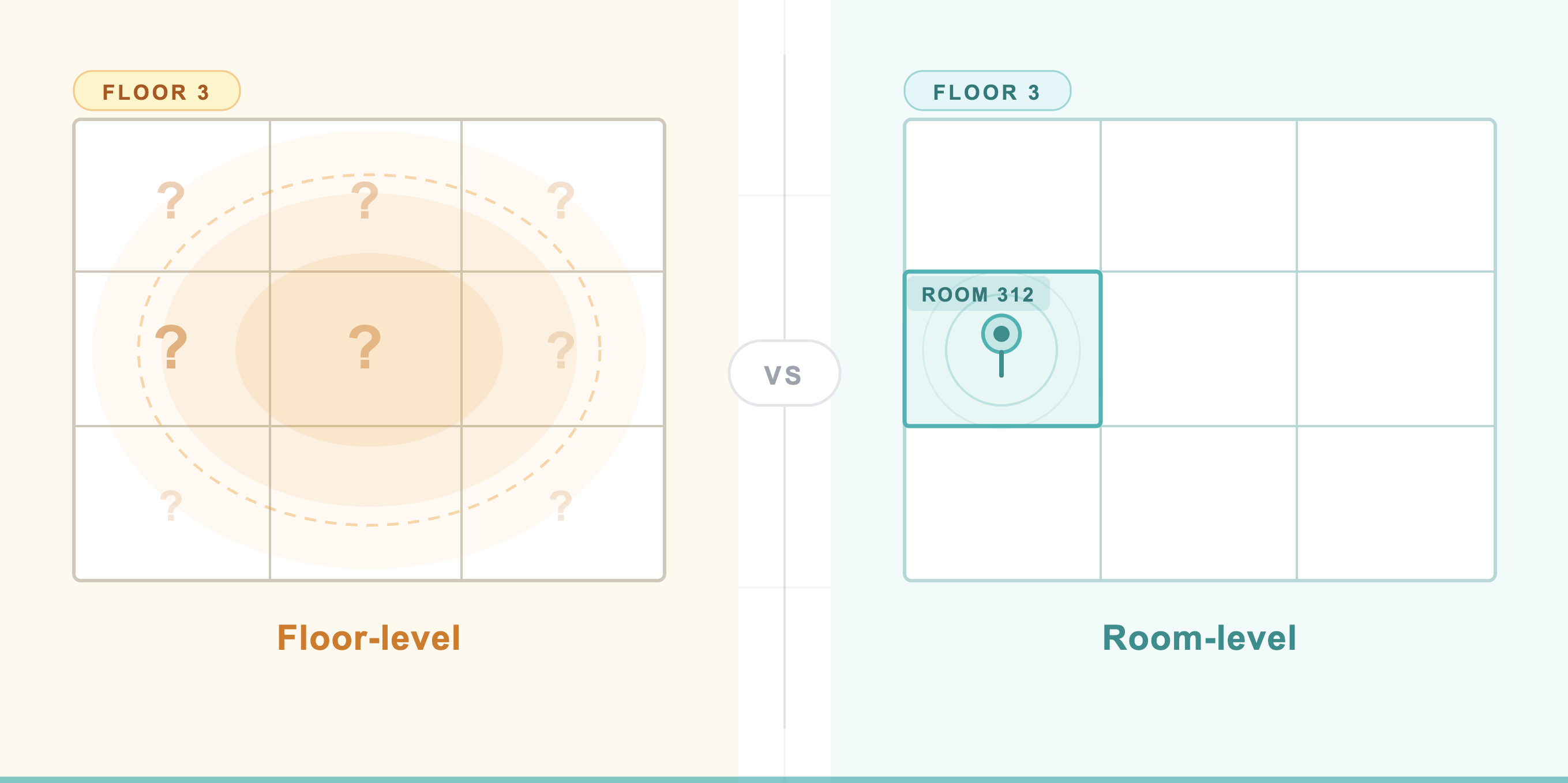
When a hotel housekeeper presses a panic button, the alert reaches a responder in seconds. But what happens next? If the responder receives a vague location (a floor number, a wing, or worse, nothing at all), those seconds become minutes. And in a genuine emergency, minutes matter enormously.
This is the gap that modern safety platforms are built to close. Panic alerts are only as effective as the location data behind them. Without precise, real-time indoor positioning, even the fastest responder can be left searching hallways and trying doors while a staff member waits for help.
This article explores why indoor location accuracy has become the cornerstone of truly effective employee safety, and what it actually looks like when a system gets it right.
Why "Floor-Level" Is No Longer Good Enough
Most legacy safety systems were designed around a simple idea: trigger an alarm, send a floor number, dispatch a responder. For small properties with few staff and compact floor plans, this approach works reasonably well. But the reality of modern hospitality, healthcare, and large campus environments is far more complex.
Consider a hotel with 600 rooms across 25 floors. A panic alert that places a staff member on "Floor 14" could mean any of 24 different rooms, two stairwells, a service corridor, or a linen closet. Responders may spend critical minutes checking the wrong areas. In a security incident, that delay is unacceptable.
The same problem applies in healthcare facilities, university campuses, and large casinos. Any environment where staff move constantly through dense, multi-zone spaces needs room-level accuracy, not floor-level approximation.
How Indoor Location Technology Has Evolved
For years, indoor positioning was genuinely difficult. GPS doesn't penetrate building walls reliably, and basic Wi-Fi triangulation offered only rough estimates. But the technology has moved significantly.
Today's enterprise safety platforms combine several positioning technologies to achieve granular, reliable indoor accuracy:
- Bluetooth Low Energy (BLE) beacons placed strategically throughout a facility create a dense positioning mesh. When a panic device is activated, the system identifies the nearest beacons and calculates a precise location, often accurate to within a single room.
- Wi-Fi-based positioning layers onto existing network infrastructure, adding redundancy and coverage in areas where beacons may be sparse.
- LoRa (Long Range) technology extends coverage to outdoor spaces, parking structures, and remote areas of large properties where traditional indoor systems reach their limits.
- 3D mapping integrates all of this positioning data into a floor-by-floor, room-by-room visual layout so responders see exactly where a staff member is, displayed on a map they can follow in real time.
The result is a system that doesn't just tell you someone needs help. It tells you exactly where to go.
What Room-Level Accuracy Looks Like in Practice
Abstract technology descriptions only go so far. Here's how precise indoor location plays out across real industries:
🏨 Hospitality
A housekeeper cleaning a room on the 11th floor is approached aggressively by a guest. She presses her panic button. The responder's app immediately displays her location: Room 1117. Security is moving toward the correct room within 15 seconds of the alert.
Without room-level accuracy: Security arrives on Floor 11 and begins checking rooms. By the time they locate her, the situation has escalated.
With room-level accuracy: Response is direct and immediate. The staff member is protected.
🏥 Healthcare
A nurse in a psychiatric unit feels unsafe during a patient interaction. She triggers an alert. The charge nurse and security see her pinned to a specific room on the ward map, not just the unit but the exact room, and respond accordingly.
In healthcare, where staff move rapidly between rooms and patients, this kind of precision is the difference between a managed situation and a dangerous one.
🎓 Education
A teacher in a large university building experiences a threatening situation during office hours. Campus security receives a location pinpointed to her specific office on the third floor of a building with hundreds of rooms. They arrive quickly, without confusion.
🎰 Casinos and Large Venues
Floor staff at a casino deal with aggressive patrons regularly. When a dealer presses their alert, surveillance and security see exactly which table they're at, not just the gaming floor. That instant precision means de-escalation happens before situations spiral.
The Role of 3D Mapping in Responder Effectiveness
Location data is only useful if responders can act on it quickly and confidently. That's where 3D mapping becomes a genuine force multiplier.
Traditional safety systems display alerts as text: "Alert triggered – Floor 7, Zone B." Modern platforms display that same alert as a pin on a live, interactive map of the building, one that responders can scroll, zoom, and navigate in real time.
This matters for several reasons:
- In multi-story buildings, 3D maps show which floor the alert is on with immediate visual clarity, with no ambiguity.
- As the situation develops, responders can see if the staff member is moving, and in which direction.
- Multiple responders can coordinate on the same map, avoiding duplication and ensuring coverage.
When paired with two-way voice communication, this creates a safety ecosystem where teams can see, talk, and coordinate simultaneously. It is something no legacy system was ever designed to do.
Compliance Is Raising the Bar, and Location Accuracy Is at the Center
Employee panic button legislation has expanded significantly in recent years. Many states and cities now require hotels and other service employers to provide personal safety devices for employees who work alone or in isolated areas. As these laws mature, regulators are increasingly paying attention not just to whether devices are in place, but whether they are effective.
Effectiveness, in practice, means location accuracy. A panic button that can't tell a responder where to go is difficult to defend as a meaningful safety measure. Organizations that have invested in precise indoor positioning are not just compliant. They are meaningfully better positioned to demonstrate that their safety programs actually protect workers.
For hospitality operators in states with active panic button mandates, and for healthcare and education organizations subject to workplace violence prevention requirements, the standard is no longer "we have panic buttons." The standard is increasingly "our panic buttons work."
What to Look for When Evaluating Indoor Positioning
Not all location systems are created equal. If your organization is evaluating or upgrading a safety platform, here are the questions worth asking:
- What is the typical location accuracy, in feet or meters, and how is that figure validated?
- Does the system offer room-level precision, or only floor or zone-level?
- How does the system handle areas with poor Wi-Fi or cellular coverage, such as stairwells, basements, and outdoor spaces?
- Is 3D mapping available, and can it be configured to match your specific floor plans?
- How quickly does location data update after a panic alert is triggered?
- Can multiple responders see and act on the same live location simultaneously?
The answers to these questions will tell you quickly whether a system is built for real-world complexity or designed around a simpler problem than the one you actually face.
Final Thoughts
A panic button is a promise to your staff: if you need help, we will come. Location accuracy is what makes that promise real.
When responders know exactly where to go, down to the room, in real time, on a map they can follow, every second of response time is used purposefully. That's the difference between a safety system and a safety program.
At React Mobile, precise indoor location has always been central to how we approach employee safety. If you're ready to see what room-level accuracy looks like in your environment, we'd be glad to show you.